This project of refurbishing a old loom took much longer than I anticipated. I had estimated it would take a month, in fact it was more like three or four. And I was lucky; although the loom was dirty and rusty, all the pieces were there (excepting a few nuts and bolts which were easily replaced) and all the parts were usable. If I had needed to replace anything significant I’m not sure how I would have gone about doing that.
By far the most time consuming part of the process was getting rid of rust. I learned more about removing rust than I knew there was to know. Thank goodness for Google! I tried white vinegar and steel wool, Coke and steel wool, naval jelly and steel wool, WD40 and steel wool, and finally electrolysis. For pieces that were not attached to wood or other non-metal pieces the electrolysis was much faster, easier, and cleaner. For pieces bolted to wood WD40 and steel wool worked best. Once the major work of removing rust was done, a quick scrubbing with aluminum foil often helped bring a shine to the metal.
I wasn’t able to salvage all of the rusted metal. Although I was able to clean much of the rust off of the reeds with a combination of electrolysis and scrubbing, I was not able to get all the rust (even after several tries), and I could see and feel that the clean dents had been roughened by the rust. I decided it was best to discard them rather than risk broken threads while weaving.
I’ve been using the loom regularly since I put it together, and it works pretty well. Early on I noticed a tendency for the metal treadle hooks which tie the treadles to the lamms to tangle with each other causing some shafts to rise when they weren’t wanted. These metal pieces are thin rods with a hook at one end that hooks onto an eyebolt on the lamm. The end of the rod opposite from the hook is bent at a right angle so the end can catch under the treadle. The right angle bend on some rods protrudes to the left side of the hook, on others to the right side. I realized that it is best to alternate the direction of the right angle bend on a treadle, especially when that treadle is tied up to several lamms, to prevent tangling.
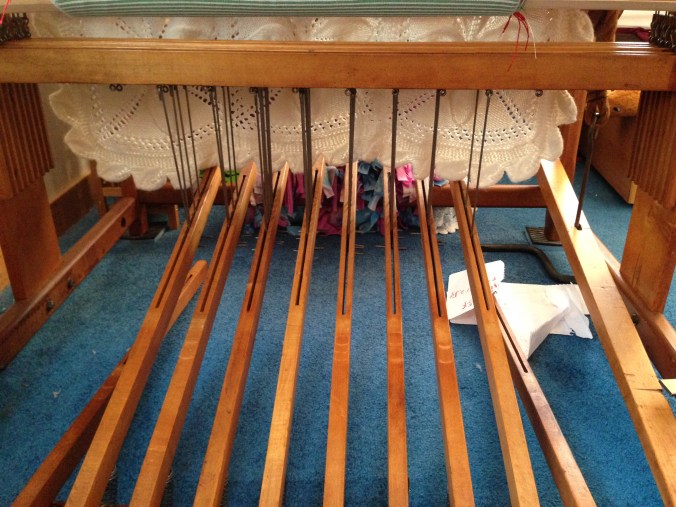
Treadle hooks tying the treadles to the lamms.
There is one issue that I still haven’t resolved. The warp beam brake is a rope that passes around a drum on the end of the beam. The rope is attached to the frame of the loom on one end, and to a long eyebolt at the other. The eyebolt gets inserted into a brake release handle and fastened with a washer and a nut. The threads on the bolt are long enough to allow the brake to be adjusted by tightening or loosening the nut. I adjusted this brake when I started my first project so it was tight and held the warp in place while I was weaving, but as I wove along it began to loosen and slip. I re-adjusted it and it held for a while and began to slip again. I repeated this process until the nut reached the top of the threads on the bolt. When the warp started to slip after that point I didn’t know what to do. I consulted with my husband (who has been very patient about staying out of the repair process until I ask for help), and he suggested adding a bunch of washers between the nut and the handle to effectively extend the length of the threads. That’s working for now. I suspect that the 70 year old rope may need to be replaced, but I find the idea of replacing it intimidating so I am putting it off as long as I can.
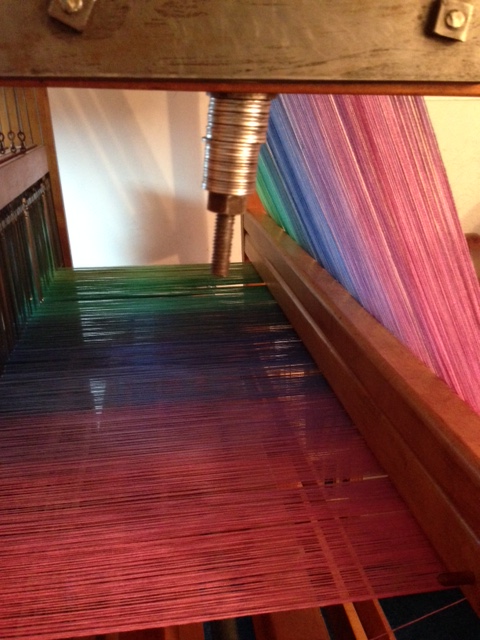
Washers extending the ability to tighten the brake


In need of a manual for Tools of the Trade 4 shaft floor loom. Can anybody help me? Desperate
LikeLike
I’ve never had a manual for my loom. Why do you need it?
LikeLike
Hi, Susan. Thank you for documenting this whole thing. It’s really helpful.
I’m having the same problem with the brake on my Binder loom, and my husband and I have just started thinking the same way you are here: replacing the rope would be a lot easier and less invasive than shortening the bolt, but we’re kind of stuck as to what kind of rope we’d use. My husband thinks it’s probably hemp, but he says hemp rope is really fuzzy, with lots of little threads of hemp sticking out like it needs a shave. But the rope on my loom is very well-shaven and smooth. Do you know what they originally used on these looms? And what did you replace yours with, assuming you did.
Thanks again, Susan,
Best,
Kathy
LikeLike
Hi Kathy, I have not replaced the rope. So far I have been able to add and remove washers from the bolt to increase and decrease tension as needed. I wonder if the changes have to do with humidity. Anyway, my understanding is that Mr. Binder used sisal rope. I hope this helps. Let me know how it goes if you replace it.
Susan
LikeLike
Thanks so much for your quick response, Susan. I have been adding lots of washers as well, but the long bolt is touching the carpet now. I either need to cut the bolt shorter, or replace the rope (which makes me really nervous). Otherwise, I love my Binder!
LikeLike
Hi Susan, I wanted to let you know that I figured something out after our conversation about the brake. Even though I always loosen the tension on my weaving when I take a break for an hour or more, I hadn’t thought of doing that with the sisal brake. Since I also started loosening the brake, I haven’t had any problems. It seems that the constant tension was stretching the sisal, but giving it time to relax shrinks it back up again!
Kathy
LikeLike
Thanks for sharing that, Kathy. I do typically loosen the tension on the rope as well. I have wondered if it the season of the year affects the sisal as well, if it is stretchier during the summer when it’s more humid, for example. Have you been getting along ok without replacing the rope?
LikeLike
The tension has been consistently good since I started loosening the brake, so no need to replace the rope!
LikeLiked by 1 person
Hi Susan,
Thank you so much for your documentation of the loom restoration process! I just acquired a 4 harness Binder loom that is currently in pieces on my living room floor. It’s in pretty good shape with not a lot of rust, thank goodness! I’m wondering if you would be willing to share more detailed photos of your loom so that I can see how it all goes together and/or the sources you found online about W H Binder. Your mini-history of him is the most complete I’ve found and I’d love to know more. I’m actually close enough to Pasadena to visit the city archives, so if I find anything more about Mr. Binder I’d be happy to share.
Best,
Kirsten
LikeLike
Hi Kristen,
I’d be happy to take more photos. I have a slight problem right now; an automobile accident took out our power this morning and the loom is in a room that doesn’t get a lot of natural light. But I’ll see what I can do. What do you want pictures of?
If you find more information about WH Binder I’d love to hear about it! I’ll have to go back into my notes and see if I can find my sources. I will let you know.
LikeLike
Hi Susan,
I hope your power is back on! There’s no rush on the photos- I’m still cleaning all the pieces. I’m particularly interested in photos of how the frame goes together and the warp beam. The treddles, harnesses, etc. are similar to the Schacht Baby Wolf I have but the frame appears to be quite different.
LikeLike
Hi Susan,
Believe it or not, I have my loom mostly put together! I haven’t tightened any bolts yet since this initial set up was more proof-of-concept than anything else. I would love photos of your braking mechanism if you have any- unfortunately, the warp beam brake is no longer on the warp beam and I have a number of detached springs and metal cranks that I can’t figure out how to attach.
Best,
Kirsten
LikeLike
See the new blog post for photos. I hope these are helpful!
LikeLike