I enjoy knowing about the history of my looms. It gives me a sense of being connected in a small way to the craft of weaving that has existed for so many centuries.
My first loom came with a label on it.
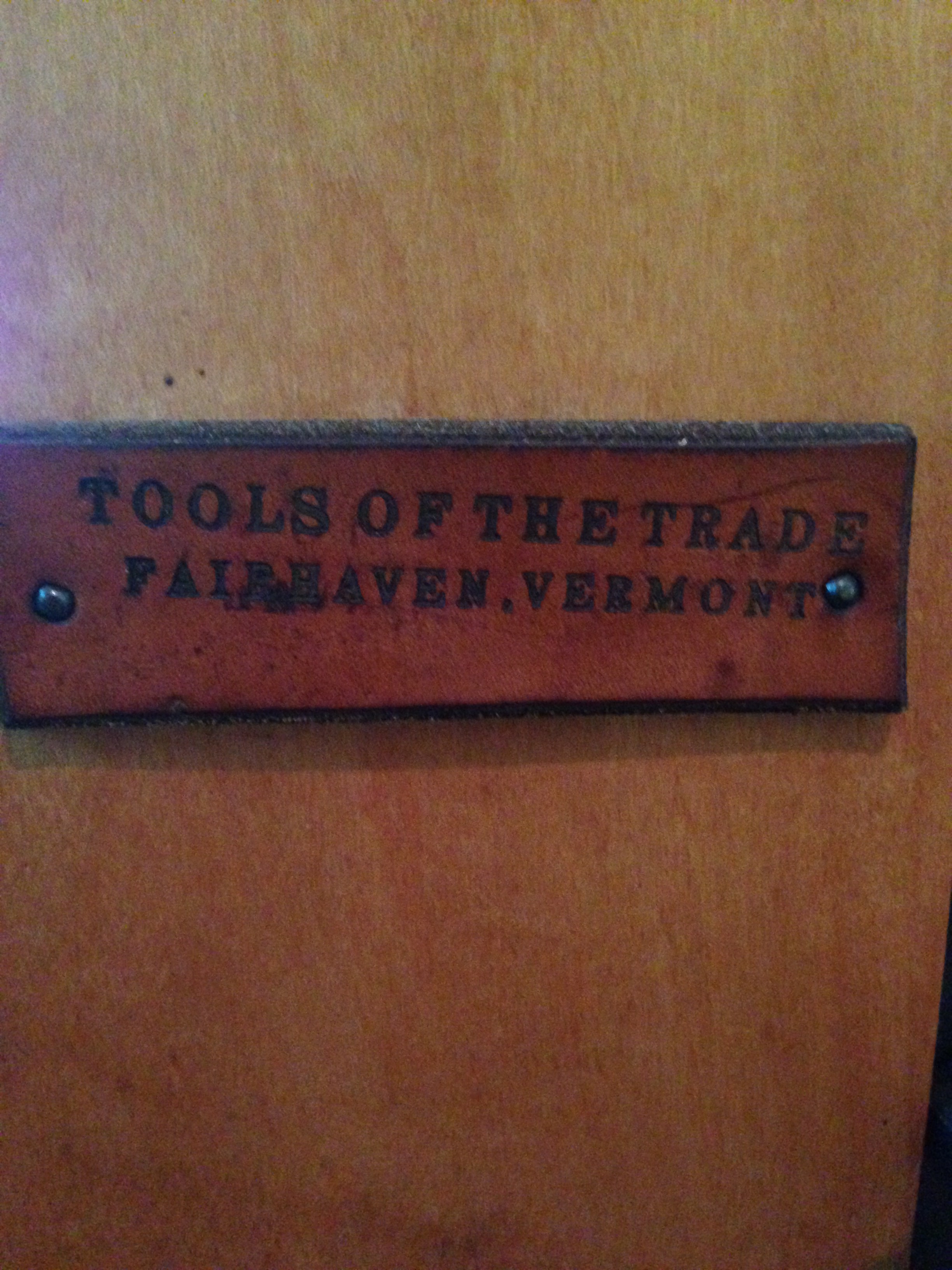
I’m familiar with some well known loom manufacturers, but I had never heard of Tools of the Trade. Googling led me to some information, much of it obtained from http://www.weavolution.com/ (the place to go for information on all things weaving-related). It seems that Tools of the Trade looms were made by a man named Art Weitzenfeld during the 1970’s and 1980’s. Most of his looms have two tags, one like you see here and another with a number on it. Mine is missing the number, so I can’t use it to help figure out exactly when the loom was made. Although Mr. Weitzenfeld is no longer making looms, he is still a furniture maker. His beautiful work can be seen here: http://www.vermontfurnituredesigns.com/ . The loom reflects his skilled craftsmanship.
When I got the loom it was in working condition, but had not been used for a while and was rather dirty. My understanding from the seller is that she had traded a larger loom to a weaving teacher for the ToTT loom which had been used by students. In spite of heavy use it is still in great shape. There were a few small parts missing, an S-hook holding the rear brake together had been replaced with what looked like a bent paperclip, and the crank for winding the warp beam was missing. The worst part was that the former owner had apparently been a smoker; the loom reeked of tobacco smoke. In order to get rid of the smell I removed anything cloth from the loom, including the yarn already on the loom as a warp, the front and rear aprons, and the cording. I washed everything with Murphy’s oil soap, added a layer of tung oil finish, replaced the aprons and cording, and I was good to go. The s-hook was not hard to replace and I was able to purchase a crank through Camilla Valley Farm in Ontario, Canada.
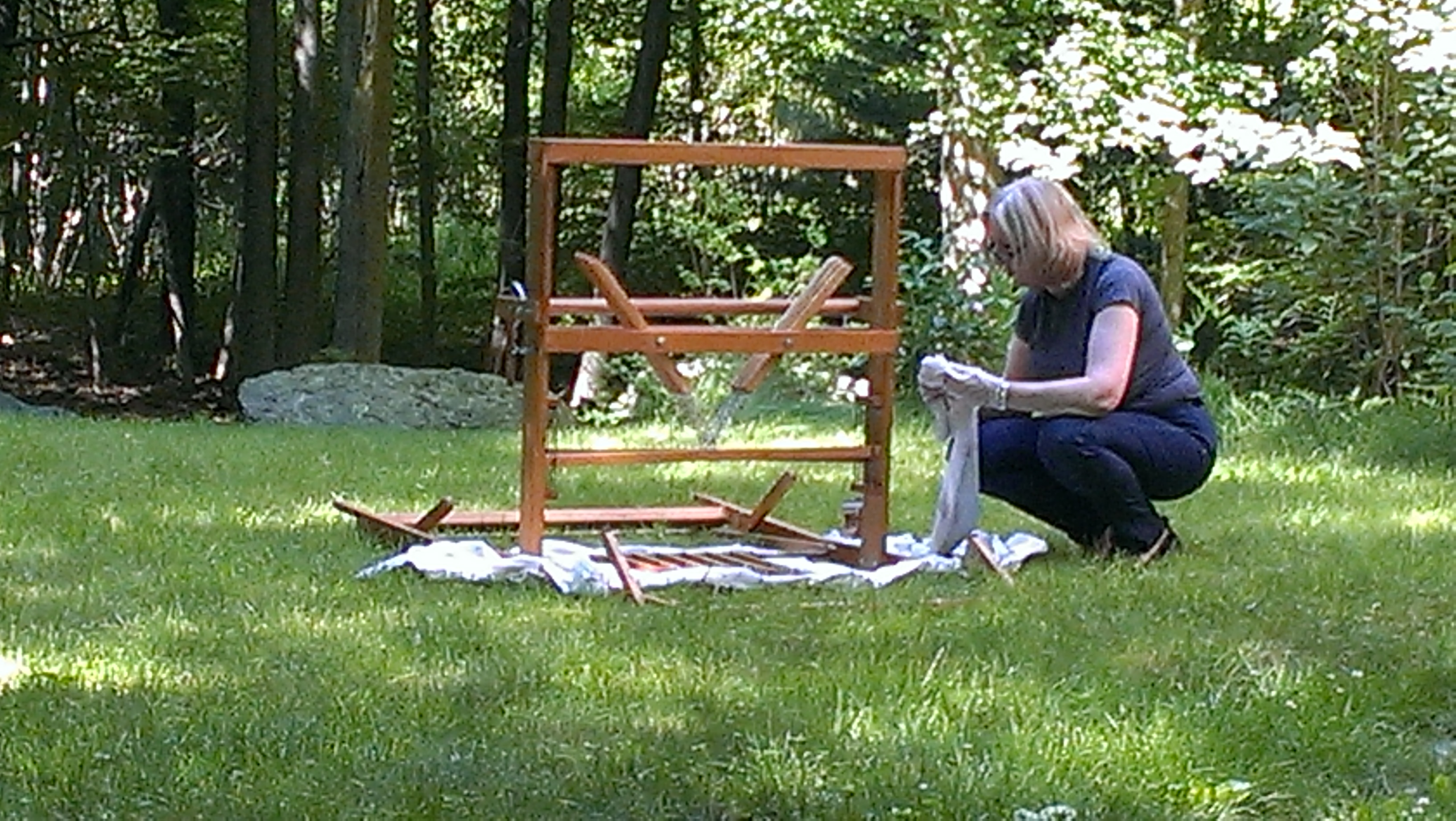
Cleaning up the ToTT loom on a lovely summer day.
I enjoyed the process of doing the small amount of restoration the loom needed as it helped me get to know the mechanism better. It also helped me to appreciate the beautiful craftsmanship of this loom. I’ve been using it for a year now and it works smoothly and easily, handling everything from fine silk scarves to heavy rugs.
When I entered negotiations to buy my most recent loom, I asked the seller if the loom had a maker’s mark of any kind. She said it did not. She told me she had purchased the loom in the 1970’s from a family friend, who had bought it in Southern California in 1946. I googled looms in California in the 40’s and came up with a few possibilities (most of the information I found came from Weavolution again). The pictures of the loom on Craig’s List showed large, slatted warp beams with a rope brake. One of the possibilities google turned up also had these features. Based on this I responded to the seller and told her that I thought she had a Binder loom. She looked through her files, and discovered that her friend had told her she purchased the loom from a man named Binder, making the identification official.
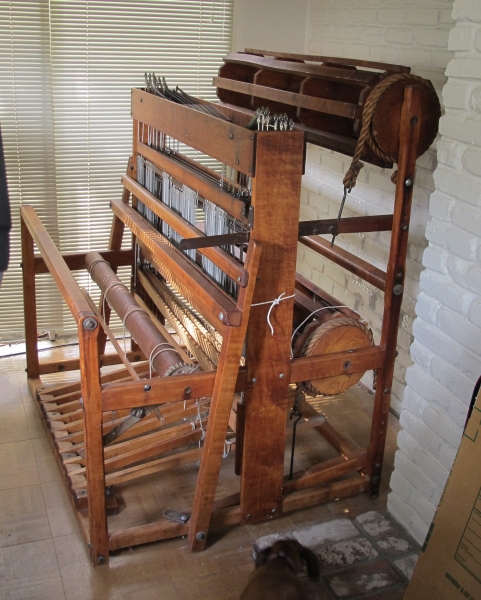
Photo of Binder loom posted at http://www.weavolution.com/forum/weaving/looking-help-identifying-vintage-floor-loom-25371. Image retrieved 7/24/2015.
According to sources on the web Mr. Binder was a weaving teacher who made looms for his students. Each loom is a little different since they were created to accommodate a specific person. This loom has two warp beams; one is a sectional beam. It’s going to take a while to get this loom up and running, but I’m excited to see what it will look like once it is all cleaned up and put back together!
 Maple Woods Handweaving
Enjoyed reading about the looms!
LikeLike
I have a Binder loom as well, in fact it is identical to your loom! The photo you posted solved the mystery of where the second warp beam should go, thanks so much!
LikeLike
The photo is not my loom, although I expect it too look a lot like that when I finally get it back together. How does your Binder loom weave? Do you like it?
LikeLike
I have two Binders, one 8 shaft and one counterbalance. I have had my 8 shaft for 43 years, purchased from the second owner in Southern California. About 10 years ago I started a thread to find other Binder owners on Weaving Today (I guess that doesn’t exist any more) and the information you stated sounds like what I originally put into the thread. If you are interested I have a picture of Mr. Binder’s studio that some one found in the archives of the historical museum of Pasadena I believe. The looms were made in Altadena. I do not have the second back beam of which I am jealous! But I do have a sectional beam. I have been wanting to do an entire clean up of my loom so your journey is very interesting to me. The counterbalance was found in the historical museum of Mammoth Lakes, donated by someone who thought every museum should have a loom. It is a tiny museum and weaving is not a tradition in that area so it was put in storage. I asked about the loom (which I had seen being used years earlier at the museum) and was told I could buy it. Before that decision was made however it spent two winters in a old shed living through snow and rain and mice eating the brake rope. When I took possession of it it was in surprisingly good shape except for water damage which is mostly cosmetic. It needs a redo as well. I am hoping to do that this summer.
Regarding the brake, I am wondering why you are having problems as mine never slipped even the tiniest bit. Is it wrapped on in the right direction? It should have the first wrap (looking from the front) on going front to back over the top of the spool and then around once more. Binders were known for their braking system being solid and trustworthy. One weaving expert I spoke to who owned a shop in Pasadena, said of all the looms he had (well over 150), the Binder was the only one that didn’t slip. My loom is not set up right now due to a move or I would send you a picture.
So glad to see another Binder saved from the stick pile at the dump! My ultimate goal is to also own a table loom from Mr. Binder. To answer your question to Tina, I love my loom. Have not woven on the counterbalance yet.
LikeLike
Hi Karen,
Thanks for your comment. As far as the brake goes it is wrapped in the way you describe. I have found that the tightness of it changes with the weather, so I’m guessing the rope expands and contracts with temperature or humidity. Adding the washers means I can adjust the amount of tension as I need to. It’s been fine since I did that. Maybe it’s the effect of a New England climate on a California loom.
I’d love to see the picture of Mr. Binder’s studio!
Susan
LikeLike
Susan,
I’m trying to connect with Arthur Weitzenfeld, the maker of the TOTT loom. I live in Vermont and have a 36″ loom.
LikeLike
Hi Paul,
I’m afraid I can’t help you to connect with Arthur Weitzenfeld. I have never met him. Everything I know about him is in this post. Can you contact him through the Vermont Furniture site?
Susan
LikeLike
Hi Karen,
I don’t know if you’ll receive this message, but I bought a loom in 2018 that I just found out is a Binder (it doesn’t have any label on it). It was originally owned by a woman in San Francisco. It’s a beautiful 50″ counterbalance, four-harness loom with a rope brake. I do have some slippage occasionally (I live in WA state, land of rain), but find adding washers tightens up the brake. I love weaving rugs on it using recycled Pendleton wool selvage. I would very much like to see your photo of Mr. Binder’s studio (is he W.H. Binder?), and learn anything you may know about Mr. Binder and his looms. Thanks so much!
LikeLike
Thank you for your information on the Binder loom. I just acquired a Binder loom and through a friend, learned that it is indeed a Binder loom. I live in Acton, CA. My loom needs some clean up and adjustments. It’s nice to know that there are other people out there with these looms.
LikeLike
I too have a Binder loom, and this one still lives in SoCal. I would love to see a photo of Mr. Binder’s studio.
LikeLike
Tell me about your loom, JoAnne. How many shafts? What size? Jack loom or counterbalance? What do you like to weave on it?
LikeLike
Hi, Susan! Thanks for your post 🙂 I just acquired a Tools of the Trade floor loom (the 35”, four harness) and while I first learned how to weave on a floor loom, it’s been a while/a lot was over my head at the time. Do you know if there’s a manual for the tools of the trade floor looms? I have looked through weavolution but I can’t seem to see the images shared on the site. I’m particularly struggling to figure out how to get the breast beam and the back beam to hold in place. the little arms keep slipping and the breast beam / back beam then fall! maybe it’s a loose screw? i know it’s a long shot, but any resources would be greatly appreciated!
LikeLike
Hi Katy,
As far as I know there’s no manual. My breast beam and back beam are held in place with two screws on each side that go through the uprights into the beam. I’m having trouble picturing what the trouble that you are having is.
Susan
LikeLike
Susan,
I’m interested in the Tools of the Trade looms and wondered what size loom you have? It’s difficult to find information about what sizes were made of these and the weaving width vs overall size. Any information you might have would be really great! Thank you!
LikeLike
I have a Binder also– 45″ 8 harness, with the fat rope brake. Very heavy, and works super well. I had a lot of trouble with the wires that were supposed to raise and lower the shafts, so I replaced them with medium weight chain. Works beautifully. It’s been in pieces for a few years while I working with my other loom (Nilus LeCler 4 harness) on technique, but am now ready to bring “The Beast” back to life and work on the next level.
LikeLike
Hi Martha, aren’t Binder looms great?! I didn’t know he made 8 harness looms, or that some of them had wires rather than twisted cord on pulleys to raise the shafts. Enjoy your weaving!
LikeLike
I have had my 8H Binder since 1973. What I learned from the woman I bought it from was that Mr Binder taught weaving in Altadena California and would make a loom for a student based on what that person was wanting to make. So in the 40s that meant a lot of counterbalance looms to meet the wishes of those that were intrigued with the interest in making rugs for a profit from one’s own home. He also of course made a wonderful 8H with its absolutely slip proof brake system. I also heard of someone who found a table loom made by him. About ten years ago I was able to acquire a 45”counterbalance loom from a small museum that needed to make room for more appropriate (for them) items. I treasure them all. Let’s keep the old ones alive and well. They hold a lot of wisdom!
LikeLike